
Items related to Fractal Solutions for Understanding Complex Systems...
Fractal Solutions for Understanding Complex Systems in Earth Sciences (Springer Earth System Sciences) - Softcover
Book 16 of 39: Springer Earth System Sciences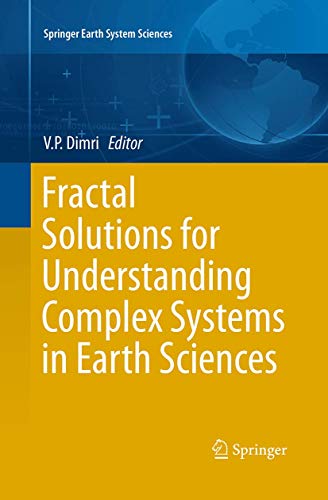
Synopsis
This book deals with fractals in understanding problems encountered in earth science, and their solutions. It starts with an analysis of two classes of methods (homogeneous fractals random models, and homogeneous source distributions or “one point” distributions) widely diffused in the geophysical community, especially for studying potential fields and their related source distributions. Subsequently, the use of fractals in potential fields is described by scaling spectral methods for estimation of curie depth. The book also presents an update of the use of the fractal concepts in geological understanding of faults and their significance in geological modelling of hydrocarbon reservoirs. Geophysical well log data provide a unique description of the subsurface lithology; here, the Detrended Fluctuation Analysis technique is presented in case studies located off the west-coast of India. Another important topic is the fractal model of continuum percolation which quantitatively reproduce the flow path geometry by applying the Poiseuille’s equation. The pattern of fracture heterogeneity in reservoir scale of natural geological formations can be viewed as spatially distributed self-similar tree structures; here, the authors present simple analytical models based on the medium structural characteristics to explain the flow in natural fractures. The Fractal Differential Adjacent Segregation (F-DAS) is an unconventional approach for fractal dimension estimation using a box count method. The present analysis provides a better understanding of variability of the system (adsorbents – adsorbate interactions). Towards the end of book, the authors discuss multi-fractal scaling properties of seismograms in order to quantify the complexity associated with high-frequency seismic signals. Finally, the book presents a review on fractal methods applied to fire point processes and satellite time-continuous signals that are sensitive to fire occurrences.
"synopsis" may belong to another edition of this title.
From the Back Cover
This book deals with fractals in understanding problems encountered in earth science, and their solutions. It starts with an analysis of two classes of methods (homogeneous fractals random models, and homogeneous source distributions or “one point” distributions) widely diffused in the geophysical community, especially for studying potential fields and their related source distributions. Subsequently, the use of fractals in potential fields is described by scaling spectral methods for estimation of curie depth. The book also presents an update of the use of the fractal concepts in geological understanding of faults and their significance in geological modelling of hydrocarbon reservoirs. Geophysical well log data provide a unique description of the subsurface lithology; here, the Detrended Fluctuation Analysis technique is presented in case studies located off the west-coast of India. Another important topic is the fractal model of continuum percolation which quantitatively reproduce the flow path geometry by applying the Poiseuille’s equation. The pattern of fracture heterogeneity in reservoir scale of natural geological formations can be viewed as spatially distributed self-similar tree structures; here, the authors present simple analytical models based on the medium structural characteristics to explain the flow in natural fractures. The Fractal Differential Adjacent Segregation (F-DAS) is an unconventional approach for fractal dimension estimation using a box count method. The present analysis provides a better understanding of variability of the system (adsorbents – adsorbate interactions). Towards the end of book, the authors discuss multi-fractal scaling properties of seismograms in order to quantify the complexity associated with high-frequency seismic signals. Finally, the book presents a review on fractal methods applied to fire point processes and satellite time-continuous signals that are sensitive to fire occurrences.
"About this title" may belong to another edition of this title.
Search results for Fractal Solutions for Understanding Complex Systems...

Stock Image
Fractal Solutions for Understanding Complex Systems in Earth Sciences (eng)
Print on DemandSeller: Brook Bookstore On Demand, Napoli, NA, Italy
Seller rating 5 out of 5 stars

Condition: new. Questo è un articolo print on demand. Seller Inventory # 41b781c895880ded6f74b6091a6016e3
Buy New
£ 75.29
£ 16.95 shipping
Ships from Italy to U.S.A.
Ships from Italy to U.S.A.
Quantity: Over 20 available
Stock Image
Fractal Solutions for Understanding Complex Systems in Earth Sciences
Seller: GreatBookPrices, Columbia, MD, U.S.A.
Seller rating 5 out of 5 stars
Condition: New. Seller Inventory # 30334265-n
Stock Image
Fractal Solutions for Understanding Complex Systems in Earth Sciences
Seller: GreatBookPrices, Columbia, MD, U.S.A.
Seller rating 5 out of 5 stars
Condition: As New. Unread book in perfect condition. Seller Inventory # 30334265
Stock Image
Fractal Solutions for Understanding Complex Systems in Earth Sciences
Seller: Chiron Media, Wallingford, United Kingdom
Seller rating 5 out of 5 stars
PF. Condition: New. Seller Inventory # 6666-IUK-9783319370781
Buy New
£ 94.58
£ 15.49 shipping
Ships from United Kingdom to U.S.A.
Ships from United Kingdom to U.S.A.
Quantity: 10 available
Seller Image
Fractal Solutions for Understanding Complex Systems in Earth Sciences
Published by
Springer International Publishing Aug 2016, 2016
ISBN 10: 3319370782
ISBN 13: 9783319370781
New
Taschenbuch
Seller: BuchWeltWeit Ludwig Meier e.K., Bergisch Gladbach, Germany
Seller rating 5 out of 5 stars
Taschenbuch. Condition: Neu. This item is printed on demand - it takes 3-4 days longer - Neuware -This book deals with fractals in understanding problems encountered in earth science, and their solutions. It starts with an analysis of two classes of methods (homogeneous fractals random models, and homogeneous source distributions or 'one point' distributions) widely diffused in the geophysical community, especially for studying potential fields and their related source distributions. Subsequently, the use of fractals in potential fields is described by scaling spectral methods for estimation of curie depth. The book also presents an update of the use of the fractal concepts in geological understanding of faults and their significance in geological modelling of hydrocarbon reservoirs. Geophysical well log data provide a unique description of the subsurface lithology; here, the Detrended Fluctuation Analysis technique is presented in case studies located off the west-coast of India. Another important topic is the fractal model of continuum percolation which quantitatively reproduce the flow path geometry by applying the Poiseuille's equation. The pattern of fracture heterogeneity in reservoir scale of natural geological formations can be viewed as spatially distributed self-similar tree structures; here, the authors present simple analytical models based on the medium structural characteristics to explain the flow in natural fractures. The Fractal Differential Adjacent Segregation (F-DAS) is an unconventional approach for fractal dimension estimation using a box count method. The present analysis provides a better understanding of variability of the system (adsorbents - adsorbate interactions). Towards the end of book, the authors discuss multi-fractal scaling properties of seismograms in order to quantify the complexity associated with high-frequency seismic signals. Finally, the book presents a review on fractal methods applied to fire point processes and satellite time-continuous signals that are sensitive to fire occurrences. 168 pp. Englisch. Seller Inventory # 9783319370781
Stock Image
Fractal Solutions for Understanding Complex Systems in Earth Sciences (Springer Earth System Sciences)
Seller: Ria Christie Collections, Uxbridge, United Kingdom
Seller rating 5 out of 5 stars
Condition: New. In English. Seller Inventory # ria9783319370781_new
Buy New
£ 106.71
£ 9.37 shipping
Ships from United Kingdom to U.S.A.
Ships from United Kingdom to U.S.A.
Quantity: Over 20 available
Seller Image
Fractal Solutions for Understanding Complex Systems in Earth Sciences
Published by
Springer International Publishing, 2016
ISBN 10: 3319370782
ISBN 13: 9783319370781
New
Softcover
Seller: moluna, Greven, Germany
Seller rating 5 out of 5 stars
Condition: New. Dieser Artikel ist ein Print on Demand Artikel und wird nach Ihrer Bestellung fuer Sie gedruckt. Comprehensive set of reviews on geophysical tools dealing with fractalsApplication oriented methods related to oil prospectingPresents new solutions to a variety of geophysical topics such as rheology and remote-sensingThis . Seller Inventory # 448748032
Buy New
£ 80.56
£ 41.52 shipping
Ships from Germany to U.S.A.
Ships from Germany to U.S.A.
Quantity: Over 20 available
Stock Image
Fractal Solutions for Understanding Complex Systems in Earth Sciences (Springer Earth System Sciences)
Seller: Books Puddle, Woodside, NY, U.S.A.
Seller rating 4 out of 5 stars

Condition: New. pp. 168 Softcover reprint of the original 1st ed. 2016 edition NO-PA16APR2015-KAP. Seller Inventory # 26379084220
Seller Image
Fractal Solutions for Understanding Complex Systems in Earth Sciences
Seller: AHA-BUCH GmbH, Einbeck, Germany
Seller rating 5 out of 5 stars
Taschenbuch. Condition: Neu. Druck auf Anfrage Neuware - Printed after ordering - This book deals with fractals in understanding problems encountered in earth science, and their solutions. It starts with an analysis of two classes of methods (homogeneous fractals random models, and homogeneous source distributions or 'one point' distributions) widely diffused in the geophysical community, especially for studying potential fields and their related source distributions. Subsequently, the use of fractals in potential fields is described by scaling spectral methods for estimation of curie depth. The book also presents an update of the use of the fractal concepts in geological understanding of faults and their significance in geological modelling of hydrocarbon reservoirs. Geophysical well log data provide a unique description of the subsurface lithology; here, the Detrended Fluctuation Analysis technique is presented in case studies located off the west-coast of India. Another important topic is the fractal model of continuum percolation which quantitatively reproduce the flow path geometry by applying the Poiseuille's equation. The pattern of fracture heterogeneity in reservoir scale of natural geological formations can be viewed as spatially distributed self-similar tree structures; here, the authors present simple analytical models based on the medium structural characteristics to explain the flow in natural fractures. The Fractal Differential Adjacent Segregation (F-DAS) is an unconventional approach for fractal dimension estimation using a box count method. The present analysis provides a better understanding of variability of the system (adsorbents - adsorbate interactions). Towards the end of book, the authors discuss multi-fractal scaling properties of seismograms in order to quantify the complexity associated with high-frequency seismic signals. Finally, the book presents a review on fractal methods applied to fire point processes and satellite time-continuous signals that are sensitive to fire occurrences. Seller Inventory # 9783319370781
Stock Image
Fractal Solutions for Understanding Complex Systems in Earth Sciences (Springer Earth System Sciences)
Print on DemandSeller: Majestic Books, Hounslow, United Kingdom
Seller rating 4 out of 5 stars
Condition: New. Print on Demand pp. 168. Seller Inventory # 384819811
Buy New
£ 137.40
£ 6.50 shipping
Ships from United Kingdom to U.S.A.
Ships from United Kingdom to U.S.A.
Quantity: 4 available