
Items related to Building Independence: How to Create and Use Structured...
Synopsis
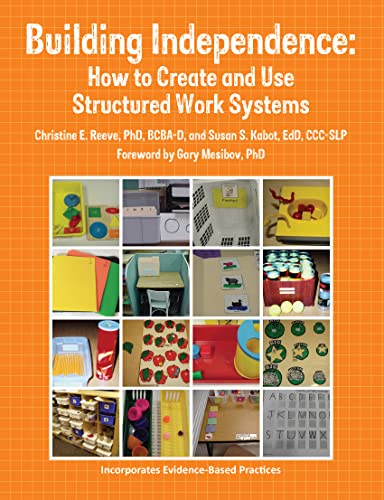
Individuals with ASD and related disorders are supported by a variety of people throughout their day, whether in educational and work settings, transition programs or at home. Structured work systems are one method that can be used to ensure that they develop and maintain their ability to work on their own, without assistance and prompting from others. Briefly, structured work systems are designed to give visual information about what work needs to be done, how much works needs to be done, when the work is completed and what will happen next. Due to the predictability and sense of accomplishment that are built into the system, many individuals with ASD find the structured work time their favourite time of the day. Full of colour photos and case examples spanning age and levels of functioning, the book provides an A-Z guide to work systems, including assessment, how to build them into the curriculum, IEPs, lesson planning and more.
"synopsis" may belong to another edition of this title.
About the Authors
Christine E. Reeve, PhD, BCBA-D, has more than 20 years of professional experience working with children, families, and schools focused on autism, inspired by one sister with autism and another sister who teaches children with special needs. During her 13 years at Nova Southeastern University's Mailman Segal Institute, she served in a variety of roles, including director of the therapeutic intervention program for children with significant behavioral issues and autism and consultant for the Autism Consortium, providing consultation and training to school systems across the country. Christine owns and directs a school consultation practice providing professional development and consultation to school systems concerning students with autism, low-incidence disabilities, and challenging behavior. Christine also serves as adjunct faculty and a dissertation advisor for Nova Southeastern University. Author and co-author of several books, including Setting up Classroom Environments That Support Children With Autism Spectrum Disorders, Christine maintains a blog regarding school-related information about autism spectrum disorders at Reeve Autism Consulting.
Susan Kabot, EdD, CCC-SLP, is the executive director of the Autism Institute at Nova Southeastern University, where she oversees the Baudhuin Preschool; Starting Right, a parent-child early intervention program for children 18-36 months; the Autism Consortium, which provides outreach services to school districts around the country; and the Unicorn Children's Foundation Clinic. She also teaches autism courses at both the master's and doctoral level at NSU and serves as a dissertation chair and member. Susan has been active at the local, state, and national level in a variety of organizations addressing the needs of individuals with autism, their families, and the professionals who serve them. She was appointed to the Florida Developmental Disabilities Council by former Florida Governor Crist and serves on the Health Care and Self-Advocacy Leadership Task Forces. She is also a member of the Panel of Professional Advisors for the Autism Society of America. With Christine Reeve, Susan is the co-author of several books, including Setting up Classroom Spaces That Support Students With Autism Spectrum Disorders. Susan is the mother of three sons. Her middle son, Michael, has autism.
Excerpt. © Reprinted by permission. All rights reserved.
While individuals on the autism spectrum and related disorders each have unique strengths and weaknesses, many are visual learners who learn best when information is presented in a structured format with a clear beginning and ending point. Structured work systems are designed to take advantage of these strengths to help individuals with ASD learn to complete tasks independently. As such, all of the students above would benefit from the use of structured work systems, originally developed by Treatment and Education of Autistic and related Communication handicapped Children (www.teacch.com) at the University of North Carolina at Chapel Hill.
Briefly, structured work systems are designed to give visual information about what work needs to be done, how much work needs to be done, when the work is completed, and what will happen next. The systems use schedules that can involve colors, shapes, numbers, letters, or symbols to indicate what work to do. Schedules can be developed with pieces that can be manipulated (moved around), written on a piece of paper, or on a smart phone or tablet. Work can be contained in baskets, file folders, Trapper Keepers® (loose-leaf binders with multiple folders), or letter trays such as in- and out-boxes. It can be arranged on a desk, on shelves, or on a work table on a job site, depending on the sophistication of the system and the skills of the individual using it. Work is always completed left to right and/or top to bottom. Students never disassemble or reassemble their work when it is completed; instead, each of the completed tasks and the containers used with them are placed in a “finished” basket or area. The number of baskets or tasks depends on the skills of the learner, as does the amount of work placed in each basket.
"About this title" may belong to another edition of this title.
Search results for Building Independence: How to Create and Use Structured...

Seller Image
Building Independence: How to Create and Use Structured Work Systems
Seller: Zoom Books East, Glendale Heights, IL, U.S.A.
Seller rating 5 out of 5 stars

Condition: good. Book is in good condition and may include underlining highlighting and minimal wear. The book can also include "From the library of" labels. May not contain miscellaneous items toys, dvds, etc. . We offer 100% money back guarantee and 24 7 customer service. Seller Inventory # ZEV.1937473090.G
Stock Image
Building Independence How to C
Seller: World of Books (was SecondSale), Montgomery, IL, U.S.A.
Seller rating 5 out of 5 stars
Condition: Good. Item in good condition. Textbooks may not include supplemental items i.e. CDs, access codes etc. Seller Inventory # 00109478854
Seller Image
Building Independence: How to Create and Use Structured Work Systems
Seller: Austin Goodwill 1101, Austin, TX, U.S.A.
Seller rating 5 out of 5 stars
Condition: good. Book shows general signs of use and handling. May have light wear on the cover or edges and minimal writing or highlighting. Binding remains tight, and pages are clean and readable. Seller Inventory # CTXV.1937473090.G
Stock Image
Building Independence: How to Create and Use Structured Work Systems
Seller: ThriftBooks-Dallas, Dallas, TX, U.S.A.
Seller rating 5 out of 5 stars
Paperback. Condition: Very Good. No Jacket. May have limited writing in cover pages. Pages are unmarked. ~ ThriftBooks: Read More, Spend Less. Seller Inventory # G1937473090I4N00
Stock Image
Building Independence: How to Create and Use Structured Work Systems
Published by
Autism Asperger Publishing Co,US, 2012
ISBN 10: 1937473090
ISBN 13: 9781937473099
Used
Paperback
Seller: World of Books Inc, Montgomery, IL, U.S.A.
Seller rating 4 out of 5 stars

Paperback. Condition: Good. Individuals with ASD and related disorders are supported by a variety of people throughout their day, whether in educational and work settings, transition programs or at home. Structured work systems are one method that can be used to ensure that they develop and maintain their ability to work on their own, without assistance and prompting from others. Briefly, structured work systems are designed to give visual information about what work needs to be done, how much works needs to be done, when the work is completed and what will happen next. Due to the predictability and sense of accomplishment that are built into the system, many individuals with ASD find the structured work time their favorite time of the day. Full of color photos and case examples spanning age and levels of functioning, the book provides an A-Z guide to work systems, including assessment, how to build them into the curriculum, IEPs, lesson planning and more. Seller Inventory # CIN1937473090G
Stock Image
Building Independence: How to Create and Use Structured Work Systems
Seller: HPB-Red, Dallas, TX, U.S.A.
Seller rating 5 out of 5 stars
Paperback. Condition: Acceptable. Connecting readers with great books since 1972. Used textbooks may not include companion materials such as access codes, etc. May have condition issues including wear and notes/highlighting. We ship orders daily and Customer Service is our top priority! Seller Inventory # S_418423008
Stock Image
Building Independence: How to Create and Use Structured Work Systems
Published by
Future Horizons (edition First Edition), 2012
ISBN 10: 1937473090
ISBN 13: 9781937473099
Used
Paperback
First Edition
Seller: BooksRun, Philadelphia, PA, U.S.A.
Seller rating 5 out of 5 stars
Paperback. Condition: Very Good. First Edition. It's a well-cared-for item that has seen limited use. The item may show minor signs of wear. All the text is legible, with all pages included. It may have slight markings and/or highlighting. Seller Inventory # 1937473090-11-1
Seller Image
Building Independence: How to Create and Use Structured Work Systems
Seller: Goodwill of Colorado, COLORADO SPRINGS, CO, U.S.A.
Seller rating 5 out of 5 stars
Condition: good. All pages and cover are intact. Dust jacket included if applicable, though it may be missing on hardcover editions. Spine and cover may show minor signs of wear including scuff marks, curls or bends to corners as well as cosmetic blemishes including stickers. Pages may contain limited notes or highlighting. "From the library of" labels may be present. Shrink wrap, dust covers, or boxed set packaging may be missing. Bundled media e.g., CDs, DVDs, access codes may not be included. Seller Inventory # COLV.1937473090.G
Seller Image
Building Independence: How to Create and Use Structured Work Systems
Seller: Goodwill Southern California, Los Angeles, CA, U.S.A.
Seller rating 5 out of 5 stars
Condition: good. Paperback Book. Seller Inventory # LACV.1937473090.G
Stock Image
Building Independence: How to Create and Use Structured Work Systems
Seller: HPB-Diamond, Dallas, TX, U.S.A.
Seller rating 5 out of 5 stars
Paperback. Condition: Very Good. Connecting readers with great books since 1972! Used books may not include companion materials, and may have some shelf wear or limited writing. We ship orders daily and Customer Service is our top priority! Seller Inventory # S_476894134