Items related to The Principles of Criminal Evidence (Clarendon Law...
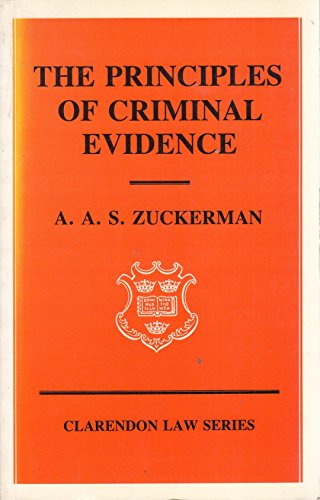

The law of criminal evidence has a cohesion of principles which requires its separate treatment. Like any procedure for determining the truth about events, it has to be evaluated by reference to its structure and its general principles. This introductory textbook on the law of criminal evidence explains that its central feature is the continual search for a balance between competing demands, the first of which is the desire to discover the truth. This desire assumes a special significance in the criminal trial where it reflects the powerful public interest in bringing offenders to justice. The second principle is the protection of the innocent from conviction, which finds expression in several rules such as the requirement of proof beyond reasonable doubt and the rule excluding evidence which may create prejudice against the second. The third principle is that of maintaining standards of propriety in the criminal process. The latter underpins the privilege against self-incrimination, affects the procedure for obtaining confessions and influences the court's attitude to improperly obtained evidence.
"synopsis" may belong to another edition of this title.
Review:
"...distinctive scholarly analysis and critique... charaterises this excellent book..." The Times Higher Education Supplement, May 2005
About the Author:
Adrian Zuckerman is a Fellow of University College, Oxford. Paul Roberts is Reader in Criminal Justice at the University of Nottingham.
"About this title" may belong to another edition of this title.
- PublisherClarendon Press
- Publication date1989
- ISBN 10 0198762348
- ISBN 13 9780198762348
- BindingPaperback
- Number of pages407
Buy New
Learn more about this copy
£ 63.33
Shipping:
£ 4.02
Within U.S.A.
Other Popular Editions of the Same Title
Top Search Results from the AbeBooks Marketplace
Stock Image
THE PRINCIPLES OF CRIMINAL EVIDE
Published by
Oxford University Press
(1989)
ISBN 10: 0198762348
ISBN 13: 9780198762348
New
Softcover
Quantity: 1
Seller:
Rating

Book Description Condition: New. New. In shrink wrap. Looks like an interesting title! 1.19. Seller Inventory # Q-0198762348
Buy New
£ 63.33
Convert currency