
Items related to Sixty Poems
Synopsis
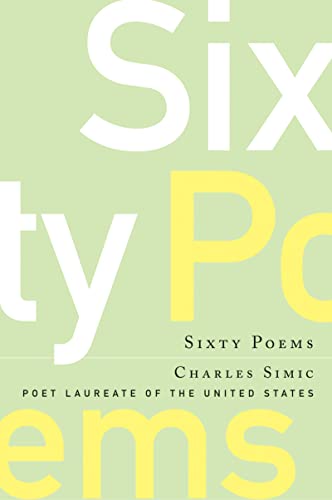
Here are sixty of Charles Simic's best known poems, collected to celebrate his appointment as the fifteenth Poet Laureate of the United States.
"synopsis" may belong to another edition of this title.
About the Author
CHARLES SIMIC was born in Belgrade and emigrated to the United States in 1954. He is the author of many books of poetry and prose. Among other honors, he received the Pulitzer Prize for Poetry in 1990 and served as the Poet Laureate of the United States in 2007-2008.
From the Back Cover
Here are sixty of Charles Simic's best-loved poems, collected to celebrate his appointment as the fifteenth poet laureate of the United States.
Charles Simic has been widely celebrated for his brilliant poetic imagery; his social, political, and moral alertness; his uncanny ability to make the ordinary extraordinary; and not least, a sardonic humor all his own. Gathering much of his material from the seemingly mundane minutia of American culture, Simic matches meditations on spiritual concerns and the weight of history with a nimble wit, shifting effortlessly to moments of clear vision and intense poetic revelation.
"Few poets have been as influential--or as inimitable--as Charles Simic." --The New York Times Book Review
"It takes just one glimpse of Charles Simic's work to establish that he is a master, ruler of his own eccentric kingdom of jittery syntax and signature insight." --Los Angeles Times
Charles Simic was born in Belgrade, Yugoslavia, in 1938, and immigrated with his parents to the United States in 1954, at the age of sixteen. Recently retired from the University of New Hampshire, where he taught American literature and creative writing, he won the Pulitzer Prize for Poetry in 1990 and held a MacArthur Foundation "genius" grant from 1984 to 1989. He is the winner of the Wallace Stevens Award from the Academy of American Poets.
Excerpt. © Reprinted by permission. All rights reserved.
From Unending Blues, 1986
toward nightfall
for Don and Jane
The weight of tragic events
On everyone’s back,
Just as tragedy
In the proper Greek sense
Was thought impossible
To compose in our day.
There were scaffolds,
Makeshift stages,
Puny figures on them,
Like small indistinct animals
Caught in the headlights
Crossing the road way ahead,
In the gray twilight
That went on hesitating
On the verge of a huge
Starless autumn night.
One could’ve been in
The back of an open truck
Hunkering because of
The speed and chill.
One could’ve been walking
With a sidelong glance
At the many troubling shapes
The bare trees made—
Like those about to shriek,
But finding themselves unable
To utter a word now.
One could’ve been in
One of these dying mill towns
Inside a small dim grocery
When the news broke.
One would’ve drawn near the radio
With the one many months pregnant
Who serves there at that hour.
Was there a smell of
Spilled blood in the air,
Or was it that other,
Much finer scent—of fear,
The fear of approaching death
One met on the empty street?
Monsters on movie posters, too,
Prominently displayed.
Then, six factory girls,
Arm in arm, laughing
As if they’ve been drinking.
At the very least, one
Could’ve been one of them:
The one with a mouth
Painted bright red,
Who feels out of sorts,
For no reason, very pale,
And so, excusing herself,
Vanishes where it says:
Rooms for Rent,
And immediately goes to bed,
Fully dressed, only
To lie with eyes open,
Trembling, despite the covers.
It’s just a bad chill,
She keeps telling herself
Not having seen the papers
Which the landlord has the dog
Bring from the front porch.
The old man never learned
To read well, and so
Reads on in that half-whisper,
And in that half-light
Verging on the dark,
About that day’s tragedies
Which supposedly are not
Tragedies in the absence of
Figures endowed with
Classic nobility of soul.
against whatever it is that’s encroaching
Best of all is to be idle,
And especially on a Thursday,
And to sip wine while studying the light:
The way it ages, yellows, turns ashen
And then hesitates forever
On the threshold of the night
That could be bringing the first frost.
It’s good to have a woman around just then,
And two is even better.
Let them whisper to each other
And eye you with a smirk.
Let them roll up their sleeves and unbutton their shirts a bit
As this fine old twilight deserves,
And the small schoolboy
Who has come home to a room almost dark
And now watches wide-eyed
The grown-ups raise their glasses to him,
The giddy-headed, red-haired woman
With eyes tightly shut,
As if she were about to cry or sing.
Compilation copyright © 2007 by Charles Simic
All rights reserved. No part of this publication may be reproduced or transmitted in any form or by any means, electronic or mechanical, including photocopy, recording, or any information storage and retrieval system, without permission in writing from the publisher.
"About this title" may belong to another edition of this title.
Search results for Sixty Poems

Stock Image
Sixty Poems
Seller: World of Books (was SecondSale), Montgomery, IL, U.S.A.
Seller rating 5 out of 5 stars

Condition: Good. Item in good condition. Textbooks may not include supplemental items i.e. CDs, access codes etc. Seller Inventory # 00103457210
Seller Image
Sixty Poems
Seller: Greenworld Books, Arlington, TX, U.S.A.
Seller rating 5 out of 5 stars
Condition: good. Fast Free Shipping â" Good condition. It may show normal signs of use, such as light writing, highlighting, or library markings, but all pages are intact and the book is fully readable. A solid, complete copy that's ready to enjoy. Seller Inventory # GWV.0156035642.G
Stock Image
Sixty Poems
Published by
Mariner Books, 2008
ISBN 10: 0156035642
ISBN 13: 9780156035644
Used
paperback
First Edition
Seller: The Maryland Book Bank, Baltimore, MD, U.S.A.
Seller rating 5 out of 5 stars
paperback. Condition: Very Good. 1st Edition. Used - Very Good. Seller Inventory # 1-H-4-1764
Stock Image
Sixty Poems
Published by
HarperCollins Publishers, 2008
ISBN 10: 0156035642
ISBN 13: 9780156035644
Used
Softcover
Seller: Better World Books, Mishawaka, IN, U.S.A.
Seller rating 5 out of 5 stars
Condition: Very Good. 1 Edition. Former library copy. Pages intact with possible writing/highlighting. Binding strong with minor wear. Dust jackets/supplements may not be included. Includes library markings. Stock photo provided. Product includes identifying sticker. Better World Books: Buy Books. Do Good. Seller Inventory # 4582748-20
Stock Image
Sixty Poems
Published by
HarperCollins Publishers, 2008
ISBN 10: 0156035642
ISBN 13: 9780156035644
Used
Softcover
Seller: Better World Books, Mishawaka, IN, U.S.A.
Seller rating 5 out of 5 stars
Condition: Good. 1 Edition. Pages intact with minimal writing/highlighting. The binding may be loose and creased. Dust jackets/supplements are not included. Stock photo provided. Product includes identifying sticker. Better World Books: Buy Books. Do Good. Seller Inventory # GRP76626263
Stock Image
Sixty Poems
Published by
HarperCollins Publishers, 2008
ISBN 10: 0156035642
ISBN 13: 9780156035644
Used
Softcover
Seller: Better World Books: West, Reno, NV, U.S.A.
Seller rating 5 out of 5 stars
Condition: Good. 1 Edition. Former library copy. Pages intact with minimal writing/highlighting. The binding may be loose and creased. Dust jackets/supplements are not included. Includes library markings. Stock photo provided. Product includes identifying sticker. Better World Books: Buy Books. Do Good. Seller Inventory # 5934357-6
Stock Image
Sixty Poems
Seller: Half Price Books Inc., Dallas, TX, U.S.A.
Seller rating 5 out of 5 stars
paperback. Condition: Very Good. Connecting readers with great books since 1972! Used books may not include companion materials, and may have some shelf wear or limited writing. We ship orders daily and Customer Service is our top priority! Seller Inventory # S_391249775
Stock Image
Sixty Poems
Seller: HPB-Ruby, Dallas, TX, U.S.A.
Seller rating 5 out of 5 stars
Paperback. Condition: Very Good. Connecting readers with great books since 1972! Used books may not include companion materials, and may have some shelf wear or limited writing. We ship orders daily and Customer Service is our top priority! Seller Inventory # S_453725579
Stock Image
Sixty Poems
Seller: World of Books Inc, Montgomery, IL, U.S.A.
Seller rating 4 out of 5 stars

Paperback. Condition: Good. Here are sixty of Charles Simic's best known poems, collected to celebrate his appointment as the fifteenth Poet Laureate of the United States. Seller Inventory # CIN0156035642G
Stock Image
Sixty Poems
Seller: ThriftBooks-Atlanta, AUSTELL, GA, U.S.A.
Seller rating 5 out of 5 stars
Paperback. Condition: Fair. No Jacket. Readable copy. Pages may have considerable notes/highlighting. ~ ThriftBooks: Read More, Spend Less. Seller Inventory # G0156035642I5N00