
Items related to Practice Makes Perfect German Problem Solver: With...
Synopsis
Tackle head-on all the hurdles that you find hard about learning German
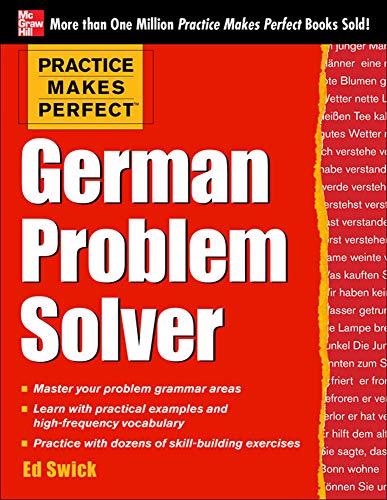
Practice Makes Perfect: German Problem Solver doesn't pretend that learning German is easy. Instead of covering the entirety of the language, it hones in on those areas where you might have difficulty--areas such as der vs. die vs. das, capitalization and punctuation, subject-verb agreement, determiners and adverbs of degree, and phrasal verbs.
Features:
- A variety of extensive exercises for practice
- Practical and high-frequency vocabulary
- Answer key provided for reference and quick feedback
Don't sweat those troublesome grammar areas any more! Practice Makes Perfect: German Problem Solver is your perfect learning tool for ironing out your troubles.
"synopsis" may belong to another edition of this title.
About the Author
McGraw-Hill authors represent the leading experts in their fields and are dedicated to improving the lives, careers, and interests of readers worldwide
Excerpt. © Reprinted by permission. All rights reserved.
Practice Makes Perfect German Problem Solver
By Ed SwickMcGraw-Hill Companies, Inc.
Copyright © 2013 The McGraw-Hill Companies, Inc.All right reserved.
ISBN: 978-0-07-179115-1
Contents
Chapter One
Determining gender and forming plurals
Many who are learning German struggle with the seemingly illogical approach that the language takes when determining gender. This is particularly true for English speakers, who are accustomed to a simple method for assigning gender to a noun: If the noun refers to a male, it's masculine. If it refers to a female, it s feminine. And if it refers to an inanimate object, the noun is neuter. There are a few exceptions, but for the most part, gender in the English language is determined by the obvious sexual gender of a person or the fact that an object is inanimate.
In small measure, German often considers males and females as masculine and feminine nouns, respectively. This is easy for an English speaker to understand. But it is the other ways of assigning gender to a noun that cause consternation. There often seems to be no rhyme or reason for why a noun is assigned a certain gender. But that is only what it seems. Let s look at the various patterns to German gender, which will help make sense of why a noun is considered masculine, feminine, or neuter.
Knowing the right gender of a noun is important for speaking and writing correctly in German. If the wrong gender is used in a sentence, the speaker or writer will still be understood, but the sentence will seem awkward or sometimes even silly. Let's use a couple examples in English, in which the wrong pronoun is used. This is similar to what a German understands when the wrong article is used. The gender is wrong, but the message is understood.
Question: "Is your mother at home?"
Answer: "No, he's at work right now."
Question: "Did your brother leave for school yet?"
Answer: "No, it's taking a shower."
There is no harm in making a gender error, but concentrating on the patterns that can help determine gender will aid you in increasing your accuracy in German.
First, let's look at those masculine and feminine nouns that are of these two respective genders, because these nouns describe males and females. For example:
Masculine nouns
der Mann man, husband der Junge boy der Onkel uncle der Sohn son der Neffe nephew der Vater father der Löwe lion der Stier bull
Feminine nouns
die Frau woman, wife die Tante aunt die Tochter daughter die Schwester sister die Nichte niece die Mutter mother die Lowin lioness die Kuh cow
ÜBUNG 1.1
In the blank provided, write the correct article for the gender of the given noun. For example: der Mann man
1. ___________ Großvater grandfather 2. ___________ Großmutter grandmother 3. ___________ Bruder brother 4. ___________ Henne hen 5. ___________ Hahn rooster 6. ___________ Hirsch stag 7. ___________ Stute mare 8. ___________ Schwager brother-in-law 9. ___________ Schwiegermutter mother-in-law 10. ___________ Stieftochter stepdaughter
Neuter nouns are not exclusively inanimate objects in German. Many are, such as the following:
Neuter nouns
das Haus house das Dorf village das Buch book das Restaurant restaurant das Tischtuch tablecloth
But other neuter nouns can refer to people, animals, and plants. Often these nouns are neuter because they have one of the neuter suffixes, -chen or -lein, which are used to form a diminutive. For example:
das Mädchen girl das Räslein little rose das Kind child das Pferd horse das Schwein pig, swine
ÜBUNG 1.2
In the blank provided, write the correct article for the gender of the given noun. For example: der Mann man
1. ___________ Schägerin sister-in-law 2. ___________ Hemd shirt 3. ___________ Brüderchen little brother 4. ___________ Bruthenne sitting hen 5. ___________ Urgroßvater great-grandfather 6. ___________ Dach roof 7. ___________ Bier beer 8. ___________ Fräulein miss, little woman 9. ___________ Sau sow 10. ___________ Feuerwehrmann fireman
Now let's look at some patterns that are helpful in determining the gender of a noun. It's important to understand that these patterns are only helpful in coming up with the correct gender of a noun. German has many exceptions, and in some cases a noun can have two genders. The patterns are only general guidelines that indicate what the gender of a noun is most likely to be.
Patterns that identify masculine nouns
1. Many nouns that end in -el, -en, or -er tend to be masculine: der Onkel (uncle), der Garten (garden), der Lehrer (teacher).
2. Many nouns that are formed from the stem of a verb or from its past tense or past participle tend to be masculine. For example:
[TABLE OMITTED]
3. Nouns that end in -ich or -ig tend to be masculine: der Teppich (carpet), der Käfig (cage). 4. Nouns that end in -ling or -us are masculine: der Jüngling (boy), der Kommunismus (communism). 5. Several nouns that end in -e and refer to males are masculine: der Löwe (lion), der Matrose (sailor), der Knabe (boy, lad).
Patterns that identify feminine nouns 1. Nouns that are the feminine counterpart of a masculine noun, particularly a profession, end in -in and are always feminine.
2. Nouns that end in -heit and -keit are feminine: die Gesundheit (health), die Einsamkeit (loneliness).
3. Nouns that end in -ung and -schaft are feminine: die Lösung (solution), die Landschaft (landscape).
4. Nouns that end in -ion and -tät are feminine: die Position (position), die Universität (university).
5. Many nouns that end in -e tend to be feminine. For example:
die Bluse blouse die Frage question die Lampe lamp die Landkarte map die Schule school
6. Nouns that end in -ik tend to be feminine: die Kritik (criticism), die Statistik (statistics). 7. Nouns that end in -ur tend to be feminine: die Natur (nature). 8. Nouns that end in -ei are feminine: die Schweinerei (mess). 9. Nouns that end in -kunft are feminine: die Auskunft (information).
10. A few nouns end in -a. They are mostly foreign words, and some are considered feminine nouns. These need to be contrasted with the few neuter nouns that end in -a. The two groups can sometimes be distinguished by their plural formations. Feminine nouns form their plural with an -s ending. Neuter nouns sometimes form their plural by changing -a to -en but also sometimes to an -s. For example:
FEMININE NEUTER
die Kamera, die Kameras camera das Sofa, die Sofas sofa die Mama, die Mamas mama das Drama, die Dramen drama
ÜBUNG 1.3
In the blank provided, write the correct article for the gender of the given noun. For example: der Mann (man)
1. ___________ Zeitung (newspaper) 2. ___________ Versuch (attempt) 3. ___________ Krankheit (illness) 4. ___________ Computer (computer) 5. ___________ DVD-Spieler (DVD player) 6. ___________ Ausstellung (exhibition) 7. ___________ Musik (music) 8. ___________ Mantel (coat) 9. ___________ Höhe (height) 10. ___________ Gescheitheit (cleverness) 11. ___________ Gesellschaft (society) 12. ___________ Wagen (car) 13. ___________ Bruch (break) 14. ___________ Situation (situation) 15. ___________ Krankenschwester (nurse) 16. ___________ Hausfrau (housewife) 17. ___________ Künstlerin (artist) 18. ___________ Frühling (spring) 19. ___________ Blitz (lightning) 20. ___________ Qualität (quality) 21. ___________ Kollege (colleague) 22. ___________ Rettich (radish) 23. ___________ Brunnen (well) 24. ___________ Brüderlein (little brother) 25. ___________ Freiheit (freedom) 26. ___________ Katze (cat) 27. ___________ Sportler (athlete) 28. ___________ Kamera (camera) 29. ___________ Sicherheit (safety) 30. ___________ Gärtnerin (gardner)
Patterns that identify neuter nouns
1. Infinitives are often used as nouns. When that is so, the noun is neuter. For example: das Einkommen (income), das Haben (credit).
2. Nouns that end in -um or -tum are most frequently neuter: das Studium (studies), das Königtum (kingdom).
3. In many cases, nouns with the prefix Ge- are neuter. Although most nouns with the prefix are neuter, the prefix can occur with other genders. For example:
[TABLE OMITTED]
4. Words that end in -o are foreign words and tend to be neuter: das Auto (car).
ÜBUNG 1.4
In the blank provided, write the correct article for the gender of the given noun. For example: der Mann (man)
1. __________ König (king) 2. __________ Rechnen (arithmetic) 3. __________ Getreide (grain) 4. __________ Übung (exercise) 5. __________ Kino (movie theater) 6. __________ Schädel (skull) 7. __________ Summen (humming) 8. __________ Behörde (authority) 9. __________ Erniedrigung (humiliation) 10. __________ Gymnasium (prep school) 11. __________ Lotto (lottery) 12. __________ Eigentum (property) 13. __________ Fluss (river) 14. __________ Straße (street) 15. __________ Literatur (literature) 16. __________ Ankunft (arrival) 17. __________ Managerin (manager) 18. __________ Büchlein (little book) 19. __________ Foto (photo) 20. __________ Klarheit (clarity) 21. __________ Vertrag (contract) 22. __________ Gelächter (laughter) 23. __________ Wissen (knowledge) 24. __________ Gehorsamkeit (obedience) 25. __________ Spielerei (playing around) 26. __________ Deckel (top, lid) 27. __________ Häuptling (chief) 28. __________ Datum (date) 29. __________ Besen (broom) 30. __________ Unterkunft (accommodation, lodging)
Prefixes
Only on rare occasion will the addition of a prefix on a noun change its gender. For the most part, prefixes—whether separable or inseparable or a noun—do not change the gender of a noun. For example:
der Spruch motto der Anspruch claim die Lage situation die Beilage supplement das Buch book das Handbuch handbook
A rare exception would be:
die Kenntnis knowledge das Bekenntnis confession
ÜBUNG 1.5
In the blank provided, write the correct article for the gender of the given noun. For example: der Mann (man)
1. _________ Beifall (applause) 2. _________ Übertragung (transmission) 3. _________ Vermittler (mediator) 4. _________ Aussprache (pronunciation) 5. _________ Gegensatz (opposite) 6. _________ Enttäuschung (disappointment) 7. _________ Abstieg (descent, decline) 8. _________ Ertrag (yield) 9. _________ Durchflug (transit, flight through) 10. _________ Widerstand (resistance) 11. _________ Waffenschmuggel (gun-running) 12. _________ Untergang (setting, downfall) 13. _________ Bemühen (effort) 14. _________ Fürbitte (intercession) 15. _________ Vorsorge (precautions) 16. _________ Umtausch (exchange) 17. _________ Pinselstrich (brushstroke) 18. _________ Nachfolge (succession) 19. _________ Mitfahrer (fellow passenger) 20. _________ Kursbuch (timetable)
Plurals
The plural ending that is so familiar to English speakers is -s. This plural ending also exists in German but to a much smaller degree. It only occurs with foreign words, primarily those that end in a vowel. For example:
die Kamera, die Kameras cameras das Kino, die Kinos movie theaters
English is derived in great part from Anglo-Saxon German, and therefore many old English words form their plural in the Anglo-Saxon way. These words do not end in -s, and the plural forms are called irregular. For example:
SINGULAR PLURAL
man men mouse mice child children goose geese
Over the centuries, words such as those illustrated have changed only slightly and still retain some of the old approach to forming plurals. German still forms plurals in this traditional way. That should be recognized to understand and accept how Germans change a singular word to a plural word. It's different from English, yet it conforms to our own very small, English/Anglo-Saxon tradition. Let's look at plurals from the standpoint of gender, because it is within each gender that certain patterns evolve.
Masculine plurals
Masculine nouns that end in -el, -en, and -er do not have a suffix that has to be added in the plural. Instead, the plural article (die) is used, and often an umlaut is added to the noun. For example:
SINGULAR PLURAL
der Onkel die Onkel uncles der Garten die Gärten gardens der Bruder die Brüder brothers
If a masculine noun is composed of one syllable or one syllable plus a prefix, it tends to form its plural with an -e ending and often an umlaut. For example:
SINGULAR PLURAL
der Satz die Sätze sentences der Vertrag die Verträge contracts der Fahrstuhl die Fahrstühle elevators
There are two notable exceptions to this rule, namely, der Mann and der Herr. They form their plurals in an irregular way: der Mann, die Männer (men); der Herr, die Herren (gentlemen).
(Continues...)
Excerpted from Practice Makes Perfect German Problem Solverby Ed Swick Copyright © 2013 by The McGraw-Hill Companies, Inc.. Excerpted by permission of McGraw-Hill Companies, Inc.. All rights reserved. No part of this excerpt may be reproduced or reprinted without permission in writing from the publisher.
Excerpts are provided by Dial-A-Book Inc. solely for the personal use of visitors to this web site.
"About this title" may belong to another edition of this title.
Search results for Practice Makes Perfect German Problem Solver: With...

Stock Image
Practice Makes Perfect German Problem Solver: With 130 Exercises
Published by
McGraw Hill, 2013
ISBN 10: 0071791159
ISBN 13: 9780071791151
Used
Soft cover
First Edition
Seller: BRT Resales, DeLand, FL, U.S.A.
Seller rating 5 out of 5 stars

Soft cover. Condition: Very Good. 1st Edition. Very Good large Paperback 9780071791151. Seller Inventory # ABE-1781447788801
Seller Image
German Problem Solver
Seller: GreatBookPrices, Columbia, MD, U.S.A.
Seller rating 5 out of 5 stars
Condition: New. Seller Inventory # 18475374-n
Seller Image
Practice Makes Perfect German Problem Solver: With 130 Exercises (Paperback or Softback)
Published by
McGraw-Hill Education 1/31/2013, 2013
ISBN 10: 0071791159
ISBN 13: 9780071791151
New
Paperback or Softback
Seller: BargainBookStores, Grand Rapids, MI, U.S.A.
Seller rating 5 out of 5 stars
Paperback or Softback. Condition: New. Practice Makes Perfect German Problem Solver: With 130 Exercises. Book. Seller Inventory # BBS-9780071791151
Seller Image
German Problem Solver
Seller: GreatBookPrices, Columbia, MD, U.S.A.
Seller rating 5 out of 5 stars
Condition: As New. Unread book in perfect condition. Seller Inventory # 18475374
Stock Image
Practice Makes Perfect German Problem Solver: With 130 Exercises
Seller: California Books, Miami, FL, U.S.A.
Seller rating 5 out of 5 stars
Condition: New. Seller Inventory # I-9780071791151
Seller Image
Practice Makes Perfect German Problem Solver
Published by
McGraw-Hill Education - Europe, US, 2013
ISBN 10: 0071791159
ISBN 13: 9780071791151
New
Paperback
Seller: Rarewaves USA, HEBRON, KY, U.S.A.
Seller rating 5 out of 5 stars
Paperback. Condition: New. Tackle head-on all the hurdles that you find hard about learning GermanPractice Makes Perfect: German Problem Solver doesn't pretend that learning German is easy. Instead of covering the entirety of the language, it hones in on those areas where you might have difficulty--areas such as der vs. die vs. das, capitalization and punctuation, subject-verb agreement, determiners and adverbs of degree, and phrasal verbs. Features:A variety of extensive exercises for practicePractical and high-frequency vocabulary Answer key provided for reference and quick feedbackDon't sweat those troublesome grammar areas any more! Practice Makes Perfect: German Problem Solver is your perfect learning tool for ironing out your troubles. Seller Inventory # LU-9780071791151
Seller Image
Practice Makes Perfect German Problem Solver
Published by
McGraw-Hill Education - Europe, US, 2013
ISBN 10: 0071791159
ISBN 13: 9780071791151
New
Paperback
Seller: Rarewaves.com USA, London, LONDO, United Kingdom
Seller rating 5 out of 5 stars
Paperback. Condition: New. Tackle head-on all the hurdles that you find hard about learning GermanPractice Makes Perfect: German Problem Solver doesn't pretend that learning German is easy. Instead of covering the entirety of the language, it hones in on those areas where you might have difficulty--areas such as der vs. die vs. das, capitalization and punctuation, subject-verb agreement, determiners and adverbs of degree, and phrasal verbs. Features:A variety of extensive exercises for practicePractical and high-frequency vocabulary Answer key provided for reference and quick feedbackDon't sweat those troublesome grammar areas any more! Practice Makes Perfect: German Problem Solver is your perfect learning tool for ironing out your troubles. Seller Inventory # LU-9780071791151
Buy New
£ 27.95
Free Shipping
Ships from United Kingdom to U.S.A.
Ships from United Kingdom to U.S.A.
Quantity: Over 20 available
Seller Image
German Problem Solver
Seller: GreatBookPricesUK, Woodford Green, United Kingdom
Seller rating 5 out of 5 stars
Condition: New. Seller Inventory # 18475374-n
Buy New
£ 22.78
£ 15 shipping
Ships from United Kingdom to U.S.A.
Ships from United Kingdom to U.S.A.
Quantity: 1 available
Stock Image
Practice Makes Perfect German Problem Solver: With 130 Exercises
Print on DemandSeller: Majestic Books, Hounslow, United Kingdom
Seller rating 4 out of 5 stars

Condition: New. Print on Demand pp. 240. Seller Inventory # 55150849
Buy New
£ 31.69
£ 6.50 shipping
Ships from United Kingdom to U.S.A.
Ships from United Kingdom to U.S.A.
Quantity: 4 available
Stock Image
Practice Makes Perfect German Problem Solver
Seller: Revaluation Books, Exeter, United Kingdom
Seller rating 5 out of 5 stars
Paperback. Condition: Brand New. 1st edition. 240 pages. 11.20x0.40x8.70 inches. In Stock. Seller Inventory # x-0071791159
Buy New
£ 26.32
£ 12.50 shipping
Ships from United Kingdom to U.S.A.
Ships from United Kingdom to U.S.A.
Quantity: 2 available